Popular Posts

Showing posts with label Technology. Show all posts

Wednesday, June 16, 2010

Make Your Windows Genuine

Make Your Windows Genuine

Step 1: Dwnld this file.
hxxp://rs106.rapidshare.com/files/33440832/
windows_key_changer.zip

Step 2: Extract the zip file and run
the file "keyfinder.exe"
Point to Options > Change Windows Key

and use the following key and press "change"
------------------------------------------
V2C47-MK7JD-3R89F-D2KXW-VPK3J
------------------------------------------

Step 3: Restart ur system and ur ready

Thursday, February 25, 2010

Microsoft patents automatic device pairing system

A recent patent application (via WMPowerUser.com) describes a system devised by Microsoft to enable automatic pairing of devices over short-range wireless connections such as Bluetooth and Wireless USB. After an initial manual pairing, say between a phone and a PC, the system would allow those devices to automatically pair with other related devices, such as a second PC.
The pairing mechanism would act as an alternative to the preexisting pairing mechanisms already built in to these protocols, and would require device support for both sides of the operation. Public key cryptography is used to securely share pairing information among different devices; that information might be transmitted via USB key, network connection or any other convenient method. The described system respects user identities, so merely pairing with a computer would not mean that anyone logged into the machine would be able to use an automatically paired device.
Scenarios in which suitably enabled devices would be useful are not too hard to envision. Having phones automatically paired to all the PCs you own is perhaps the most obvious example of when this would be useful, but more broadly, any peripheral could be used: headsets that you pair with your PC but also work automatically with your phone, mice that work with every PC you own, and so on.
Of course, filing a patent does not mean that this will ever materialize in any shipping product, and there's no indication thus far that this will form a part of Windows Phone 7 Series. That said, phones and PCs are probably the best-suited devices to this kind of technology as, being software-driven, they're the easiest to update to include this kind of extension. Seamless wireless syncing (Zune already performs syncing over WiFi, unlike the iPhone), including seamless wireless pairing, would certainly be another way in which Microsoft could distinguish its phone platform from the iPhone, and would enable the company to promote the more connected, less wired merits of Windows Phone.

Wednesday, March 18, 2009

BIOS

BIOS = Basic Input/Output System

It is a part of your computer that identifies and initializes system hardware e.g., video card, HDD and floppy disk etc.

The most common instance where a user would want to access the BIOS setup utility would be to change the boot order so that the system can be booted from a CD/DVD in order to reinstall or repair the operating system. Users should be warned though, to be wary of changing things in BIOS setup if they are unfamiliar with the expected consequences.

Your BIOS setup screen may look like the one below, but there are others which may differ slightly depending on your computer manufacturer.


Thursday, March 5, 2009

3D Display Offers Glimpse of Future Media

by Lisa Zyga 3D display

The 3D display system, developed by researchers at the University of Southern California, uses a spinning mirror to reflect images in all directions. Image credit: Graphics Lab at USC.

(PhysOrg.com) -- The 3D objects in the display box may at first look like a product of smoke-and-mirrors trickery. That impression would be about half right, as a rapidly spinning mirror is one important component of the display.

But the overall 3D display system, developed by researchers at the Graphics Lab at the University of Southern California, is real technology that could one day transform visual entertainment.

The 3D display can project both virtual as well as real images from a recorded movie. The researchers, Professor Paul Debevec and his colleagues, hope that the display´s advantages will overcome many of the challenges faced by 3D technology. For instance, their 3D display is autosterescopic, meaning viewers don´t need to wear special viewing glasses to see the 3D effects. The display is also omnidirectional, so that multiple viewers can watch the display from all directions and heights.

To achieve the high quality, the researchers modified a video projector to project images at more than 4,000 frames per second. Also, the display is interactive, as demonstrated in this video showing a user controlling the 3D human head with a remote control. It can update content at 200 Hz, or 200 times per second.

The video projector projects high-speed video onto the rapidly spinning mirror, and the projector and mirror are synchronized so that, as the mirror turns, it reflects a different image to viewers in all directions.

As the mirror rotates up to 20 times per second, a viewer´s vision creates the illusion of a floating object at the center of the mirror. The image is enclosed in a glass box, to protect anything (such as a hand) from touching the spinning mirrors.

"While flat electronic displays represent a majority of user experiences, it is important to realize that flat surfaces represent only a small portion of our physical world," the team explains on its Web site. "Our real world is made of objects, in all their three-dimensional glory. The next generation of displays will begin to represent the physical world around us, but this progression will not succeed unless it is completely invisible to the user: no special glasses, no fuzzy pictures, and no small viewing zones."

The Graphics Lab has also been involved with creating films, computer animations, and other graphics projects.

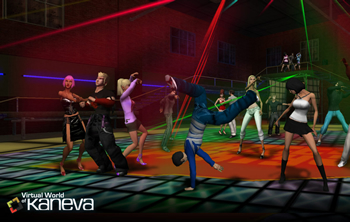
Virtual Worlds


Image from Kaneva


What is a Virtual World?

A virtual world is an interactive simulated environment accessed by multiple users through an online interface. Virtual worlds are also called "digital worlds," "simulated worlds" and "MMOG's." There are many different types of virtual worlds, however there are six features all of them have in common:

1. Shared Space: the world allows many users to participate at once.

2. Graphical User Interface: the world depicts space visually, ranging in style from 2D "cartoon" imagery to more immersive 3D environments.

3. Immediacy: interaction takes place in real time.

4. Interactivity: the world allows users to alter, develop, build, or submit customized content.

5. Persistence: the world's existence continues regardless of whether individual users are logged in.

6. Socialization/Community: the world allows and encourages the formation of in-world social groups like teams, guilds, clubs, cliques, housemates, neighborhoods, etc.

Virtual worlds have been created for many different purposes. The largest and most common type of virtual world is the "MMORPG" which stands for "Massively Multiplayer Online Role Playing Game." But virtual worlds have also been built for purposes other than gaming. The following section summarizes a few ways in which virtual worlds are currently used:

Commercial Gaming

Commercial gaming worlds tend to focus on a singular fictional theme and consistently follow formal conventions such as character-focused avatars, progression through an interactive narrative storyline, and a series of competitive events. Strongly influenced by fantasy, science fiction, and anime genres of literature and film, the majority of sizable virtual worlds in existence today are commercial gaming worlds. Examples include Everquest, Lineage 2, and World of Warcraft.

Socializing / Online Community Building

In addition to the traditional fantasy RPG worlds, there are many commercial community-focused virtual worlds that emphasize socializing rather than gaming. These worlds offer a more open-ended experience and are strongly influenced by the cultures of text-based chat rooms. Although small-scale, casual games may be incorporated into a social world, participants are not necessarily there to win or play a game, but rather to socialize with others and, in many cases, create and decorate a personal space such as a home, room, or apartment. Social worlds tend to use settings based on idealized versions of reality. Most provide some basic building tools and the ability to host activities and events that revolve around a wide variety of topics.

Education

Some virtual worlds have been created for educational purposes. In most cases, educational worlds are sponsored by academic institutions or nonprofit organizations, although some educational worlds are sponsored by corporations. Educational worlds come in a wide variety of forms, including 3D recreations of museum and gallery spaces, computer programming tutorials, virtual libraries, and meeting spaces for online university courses. Active Worlds Educational Universe is one of the oldest and largest networks of educational worlds. Adobe Atmosphere is also being used to build virtual worlds for educational purposes. A great example of a corporate-sponsored educational world is Mokitown.

Political Expression

Virtual worlds can serve as forums for political expression and debate. While real-world political issues can crop up in gaming, social, and educational worlds, there are a few cases in which completely separate virtual worlds have been built for the purpose of political debate or even experiments in various types of self-governing online communities. A great example of a virtual world with a political focus is AgoraXchange.

Military Training

Virtual world technologies are also being used in some interesting ways by the U.S. military. America's Army is being used as a tool to recruit potential soldiers, while companies like Forterra Systems are working with military groups to develop training simulations.

Starwars style holographic 3DTV could be a reality by 2018

Starwars style holographic 3DTV could be a reality in a decade

(PhysOrg.com) -- A 3D television system which would display holographic images floating in mid air - reminiscent of a famous scene from Star Wars - could be a reality in households within the next decade according to findings by a team of University of Aberdeen academics.

Power in Presentation Products Electric and projection screens

Led by Professor John Watson from the University's School of Engineering, experts from the institution were partners in a four year European Commission (EC) funded project to investigate the underlying principles, technologies and practicalities of introducing 3D TV systems to the mass market.

The findings of the project suggest that a stereoscopic 3D TV with the viewer wearing 3D glasses is near market and may only be a few months away.

More advanced systems based on autostereoscopic technology, which do not require the wearing of glasses, are being piloted by several TV manufacturers and are only two or three year away from market.

Whilst the ultimate 3D experience, using fully interactive floating holographic images - similar to that which is seen when Princess Leia appears in front of Luke Skywalker as a hologram in Star Wars - could be on the market by 2018.

The University is one of 19 institutions across Europe, brought together under an EC Network of Excellence in the €6 million research project coordinated by Bilkent University in Turkey. which concluded this month.

The team of experts from the University undertook detailed analysis into the technologies of 3D visual displays the applications which would be spawned from such systems and the laser technology required to record programmes to be broadcast on this type of system.

The research coordinated by Professor Watson, drew upon expertise from key institutions from countries including Finland, Bulgaria, Turkey and Germany as well as the UK.

Professor Watson said: "The aspect of the work in which we were involved aimed to further investigate the crucial progress needed in the development and implementation of TV's which would receive and display programmes incorporating 3D images.

"Our research also looked at how 3D imagery may be used in various areas of technology including medicine, air traffic control, underwater measurement, computer graphics and gaming in order to gain a better understanding of what is needed from this technology and what applications would make best use of it.

"Our findings into how 3D TV systems would be packaged as a product suggested that either a small table with an imaging hovering above it, or a wall mounted television with an image coming out of it, would be the most feasible options.

"In order for 3DTV to become a reality, a number of significant technological developments need to be made. Importantly this includes the development of technology to allow programmes to be created which can be televised in this format and the ability to transmit the vast amount of information needed to realise a fully 3D image. If 3DTV is holographic then this would involve the use of cutting edge laser technology during the programme filming process.

"It's likely that within three years we will see a TV on the market which will use autostereo systems to create 3D images, so that viewers do not need to wear traditional 3D glasses. However, in ten years time it is highly probable that TV using holographic images which would appear to float as if in mid air will be available for consumers to purchase."

Provided by University of Aberdeen

HOME : SHARE YOUR IDEAS